
What Happens When the Money Doesn't Arrive?
Lessons from a £1.47 million back-to-back property transaction
On 19 January 2026, the day before completion, the buyer asked for more time.
On paper, my client's position was enviable. Through a newly formed company, it had contracted to buy two adjoining office buildings in a Thames Valley town centre for £1,014,850. On the same day, it had contracted to sell them for £1,470,000. The £455,150 spread was value the client now stood to capture. Most of it traced back to planning work for a residential conversion, carried out before the client had any binding right to acquire the site. The structure was designed so that very little of the client's own capital would be needed to complete. The buyer's money would fund the purchase.
Then the buyer's original funding fell away, and the request for more time was the symptom.
At that moment the structure looked very different. The client remained unconditionally bound to its own seller, an offshore company that would shortly decline to give it any more time. The £941,100 balance due upstream had been expected to come from downstream. If it did not arrive, the client either found the money itself or faced losing its deposit, a damages claim and eighteen months of work.
The transaction completed and the client realised a substantial return. But how it completed, and why it nearly did not, says more about capital-light property structures than the profit does. This article sets out where the value came from, where the risk went, what actually saved the deal and what I would do differently.
Value before ownership
The buildings were tired offices with a G energy performance rating, which makes new lettings difficult under the minimum energy efficiency rules. As office investments they had limited appeal. As a residential conversion opportunity they were worth considerably more.
My client saw that before it had secured the site. Over roughly eighteen months it spent around £100,000 on planning and pre-contract work, without an exchanged contract or an option. That is an unusual risk, and not one I would recommend as a matter of course. It is also where everything that followed began. By the time contracts were exchanged, the consent had turned an office building with a letting problem into a residential development site, and the price reflected it.
This is the first point worth isolating. The value in this transaction was created before the client owned anything, or had any binding right to buy. It did not come from the contracts. It came from planning work carried out by a party that did not yet have a binding right to acquire the land.
The plan that time broke
The original plan was conventional: acquire with bridging finance, refinance onto development finance, convert and sell the units. Legal work on the finance had begun.
Then the transaction slowed. The owner was a British Virgin Islands company, which meant a BVI legal opinion, certificates of good standing and heavier anti-money laundering scrutiny on both sides. The register carried a restriction in favour of a management company that had since been dissolved, and leases that had been surrendered but not yet removed from the title. The seller's solicitors had applications pending at HM Land Registry to deal with both, and much of the autumn went on negotiating undertakings about what would happen if those applications stalled.
None of these problems was fatal on its own. Together they consumed time, and time changed the economics. By November 2025 the client was concerned that its funder might withdraw as the Autumn Budget approached. A develop-out plan that depended on finance the client no longer trusted had become a worse plan than it was at the start, although nothing about the building had changed.
I think advisers underrate this. A structure is chosen at a particular moment, on assumptions about time, cost and funding. When those assumptions move, the structure can stop being right without anything going wrong in the conventional sense.
Selling the opportunity, not the building
The decision to sell on rather than build out was the client's. Other routes were briefly considered and discounted as more complicated than a straightforward onward sale.
I would not describe the pivot as a retreat. It was a reallocation of risk. The client had already done the part of the project it was best placed to do: it had created the planning value. What remained was construction, development finance and unit sales, which carried risk the client no longer needed to take to realise most of the return. Selling the consented opportunity crystallised the uplift and passed the build-out risk to a party that wanted it.
The site was marketed to two prospective buyers in the summer of 2025. The eventual purchaser was a special purpose company intending to fund its acquisition with senior debt.
How the structure worked
The structure was a back-to-back sale using two separate contracts, both dated the same date.
Under the upstream contract, the offshore owner agreed to sell to the client's special purpose company for £1,014,850. The deposit was £73,750, just over 7%, held by the seller's solicitors as stakeholder. The completion date was 16 February 2026, or earlier on the buyer's notice.
Under the sub-sale, the client's SPV agreed to sell to the end buyer for £1,470,000. The deposit was £73,500, or 5%, held by my firm as agent for the client's SPV rather than as stakeholder. The completion date was 20 January 2026. The sub-sale incorporated Part 1 of the Standard Commercial Property Conditions (Third Edition – 2018 Revision).
Using a separate onward contract rather than an assignment matters. The Standard Commercial Property Conditions prevent a buyer from transferring the benefit of the contract. An assignment would in any event have required the owner's co-operation and exposed the premium. A separate contract leaves the upstream contract untouched: the intermediary remains the buyer upstream and becomes a seller downstream.
Three features of the structure matter for what follows.
The deposits. The downstream deposit, held as agent, was available to the client's SPV once the sub-sale exchanged, and it was almost exactly the size of the upstream deposit. Economically, the end buyer's deposit funded the client's.
The completion mechanism. The sub-sale annexed a form of undertaking to be given by my firm to the end buyer's solicitors. It was the mechanism by which downstream money would fund the upstream completion. On receipt of the end buyer's completion money, my firm would hold it to the end buyer's solicitors' order until the client's SPV could complete upstream. The upstream price would then pass to the owner's solicitors, the upstream purchase would complete and the sub-sale would complete immediately afterwards.
The dates. The downstream completion date was 20 January; the upstream date was 16 February, with the client's SPV free to complete earlier on notice. That 27-day gap was deliberate. It was my advice, as a hedge. If the end buyer was ready on time, the client could call for early completion upstream. If it was not, the client would not be in default to its own seller on the same day.
In the ordinary course, completion would run like this:
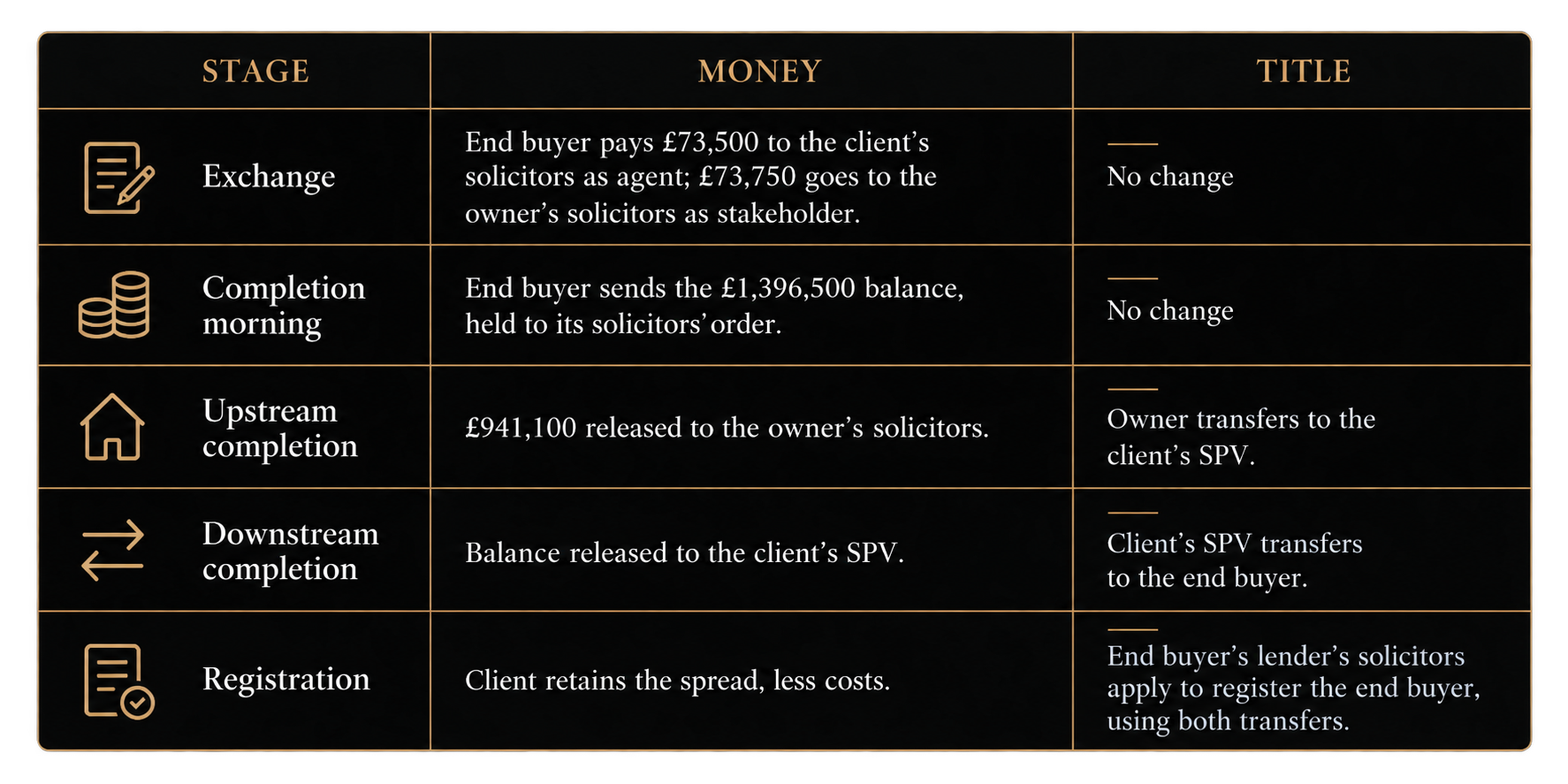
On stamp duty land tax, paragraph 16 of Schedule 2A to the Finance Act 2003 relieves the intermediate purchaser's acquisition where the onward contract is a qualifying subsale performed at the same time as, and in connection with, the upstream contract. The relief must be claimed in a land transaction return and is unavailable where the subsale forms part of tax-avoidance arrangements. Relief was claimed here. The end buyer's own acquisition was chargeable in the ordinary way.
Nor, in the ordinary course of a sub-sale, need the intermediary become the registered proprietor. Legal title to registered land passes on registration, and the end buyer's application carries both transfers.
Where the risk went
The attraction of the structure was that it needed very little of the client's capital. That is true, and it is where the analysis usually stops. It should not.
Consider the exchange itself. The owner wanted its contract exchanged first, and the client was willing to accommodate it. The upstream contract exchanged at 10:48 on 25 November; the sub-sale exchanged at 12:40, i.e. later the same day. For a little under two hours, the client was unconditionally bound to buy a £1 million building with no binding contract to sell it. The client had prepared backup funds for that window. The exposure was short and covered, but it was real. It illustrates the point exactly: the structure did not remove the client's obligation to buy. It arranged for someone else's money to be available to meet it.
Once both contracts had exchanged, the client's cash at risk was small. Its contractual exposure was not. It owed its seller £941,100 on or before 16 February, whether or not the end buyer paid. Had it failed to complete, the upstream contract required it to top its deposit up to 10% of the price, and it faced rescission, forfeiture and damages. That exposure lasted twelve weeks.
This is the difference between cash exposure and economic exposure, and it is why I am wary of the phrase "no money down". In a back-to-back structure, the intermediary's capital requirement is replaced by a dependency: on the end buyer's willingness to complete, on the end buyer's lender, on the timing of both, and on the drafting that ties them together. Capital efficiency did not eliminate the risk in this transaction. It changed its composition. The client avoided tying up acquisition capital, taking on bridging and development debt, and carrying construction, holding-period and unit-sales risk. In their place it took on counterparty, funding and sequencing risk, concentrated into a narrow window of execution.
Several features of the documents concentrated that risk further.
The top-up provisions were asymmetric. Upstream, if the client failed to complete on the completion date, its obligation to top the deposit up to 10% arose automatically. Downstream, the end buyer's equivalent obligation arose only under condition 9.8.3 of the Standard Commercial Property Conditions, on receipt of a notice to complete. The intermediary was exposed on harder terms upstream than it could impose downstream.
The two contracts were tied more tightly than they looked. The sub-sale prevented the client's SPV from varying the upstream contract without the end buyer's consent. Even the client's own request to the owner for more time was, in form, a matter the defaulting buyer could influence.
The end buyer's lender was in the chain without being party to either contract. Its requirements shaped the undertakings, the registration arrangements and, later, a refreshed BVI opinion. A lender arriving late with new conditions can delay completion as effectively as a buyer that cannot pay.
The day the model broke
The end buyer's original funding did not survive to completion. On 19 January its solicitors asked for more time. On 20 January, completion did not happen.
At that point the transaction changed character. Before exchange, the client could have walked away from a site on which it had spent £100,000, and in November it had come close to doing so. After exchange, walking away was no longer available. It was bound upstream, and the money it was relying on to perform had not arrived on the date it was due.
A notice to complete was served on 20 January. Under the Standard Commercial Property Conditions, a buyer that has paid less than 10% must, on receipt of the notice, top the deposit up to 10% without delay, and the parties must complete within ten working days, with time of the essence. The top-up was not paid.
The end buyer's solicitors did not simply ask for time. They argued that the client was not entitled to serve a notice at all, relying on the opening words of the completion clause:
"Subject to the Seller completing the purchase of the Property from the Top Contract Seller pursuant to the Top Contract, completion shall take place on the Completion Date…"
On their reading, that was a condition precedent. Until the client had completed its own purchase, the end buyer's obligation to complete had not arisen; the client was therefore not ready, able and willing, and the notice was bad. They also characterised the pre-completion undertaking as an impermissible credit facility, under which their client had no obligation to send anything in advance.
The counter-argument was respectable. Under the Standard Commercial Property Conditions, a party is ready, able and willing to complete if it would be so but for the default of the other party. The only reason the client's SPV could not complete upstream on 20 January was that the end buyer had not provided the money the structure required, and the SPV could have called for early upstream completion at any time. "Subject to" arguably governed the sequence on the day, not whether the downstream obligation existed at all. The validity of the notice was disputed on other grounds too. None of it was ever tested.
What interests me most in hindsight is that the end buyer's argument had real textual support. The funding mechanism on which the whole structure depended was drafted as an undertaking to be given by the seller's solicitors, operating on receipt of the buyer's money. Nothing in the contract obliged the buyer to send that money early. The engine of the transaction sat on the wrong side of the contract.
What actually saved it
The rescue did not look the way I expected.
On 27 January, the client wrote treating the end buyer's defaults, including its failure to pay the top-up, as bringing the contract to an end. On 28 January, the owner declined to give the client any more time. Through late January and early February, negotiations through the selling agents produced a draft supplemental agreement with a fixed completion date, time of the essence and a substantial additional deposit. It was never signed, and the additional deposit was never paid.
The transaction completed on 16 February 2026, on the original sub-sale contract, at the original price. The end buyer, now funded by a replacement lender, paid the balance with contractual late-completion interest for the 28 days from 20 January, £9,373.77, and the £810 cost of the owner's BVI authority. The upstream purchase completed the same day, on its own contractual completion date.
Four things did the work.
The buffer. Because the upstream completion date was 16 February, the end buyer's 27-day default cost the client nothing upstream. The owner's refusal to extend, which would have been decisive had the dates been aligned, never bit. The buffer prevented the downstream default from becoming an upstream default; ultimately, the delay produced an interest receipt rather than an upstream loss. This was the one part of the risk architecture designed for failure, and it was the part that held.
The end buyer's own exposure. It had a deposit at stake, a lender that had committed and a site it wanted. The pressure that produced completion came less from the client's remedies than from the end buyer's interest in not losing the transaction. When the end buyer offered money to be held to order during the negotiations, the figure was £147,000: exactly 10% of the price, which is what the contract condition required and no more. At various points the client asked for materially more commitment than that. The contract did not entitle it to more, and in the end it did not get more.
The legal position on termination. A letter declaring that a contract has ended does not necessarily end it. If the ground relied on proves wrong, the letter risks being treated as a repudiation in its own right. The courts, however, are slow to treat a genuine but mistaken reliance on a contractual right to rescind as repudiatory unless the party's conduct otherwise shows an intention to abandon the contract. Here, the parties simply went on to complete on the original terms. The 27 January letter protected the client's position without, in the event, ending the deal. I would not rely on that outcome twice.
The fallback. The client and its broker had arranged standby bridge finance, and the lender's solicitors had sent me their requirements. The client never instructed me to proceed. I cannot say the end buyer knew of it, or that it moved the negotiation. What it gave the client was optionality: had the end buyer failed on 16 February, there was a prepared route to complete upstream, take title and resell. That route was never tested, and its value would have depended on how quickly a bridging lender could actually fund.
The client received a little under £395,000 from completion, after costs. Against roughly £100,000 of planning and pre-contract expenditure put at risk over about eighteen months, that is a strong outcome. It was also an outcome that depended on the other side choosing to complete.
A structure that succeeded is not the same as a structure that was robust
It is tempting to judge a transaction by its outcome. This one completed and produced a large profit, so the structure worked. That is true, and it is incomplete. The better test is to ask what would have happened had the assumptions failed differently.
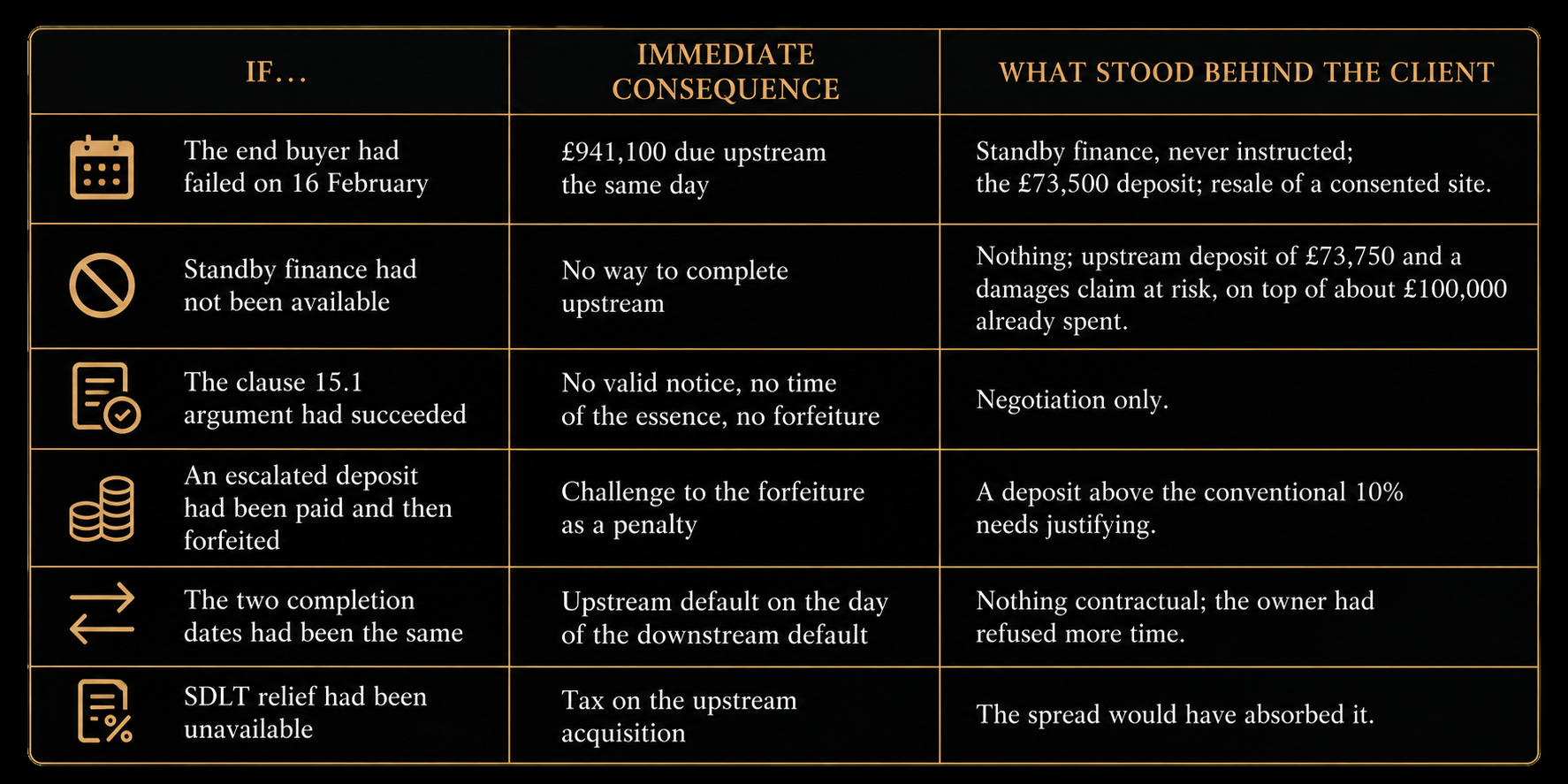
Read across the rows and the pattern is clear. The spread was ample for the risks that could be priced. It was thin against the one that could not: being forced to complete a £1 million purchase without the buyer's money.
The timing was robust because it had been designed to be. The completion mechanism was fragile, because it depended on a step the buyer had not promised to take. The enforcement position was arguable rather than strong. The fallback existed but was never tested. That is not a criticism of the outcome. It is a description of what the outcome depended on.
What I learned
Value can precede ownership. The largest single contribution to the profit was the planning work done before the client had any binding right to acquire. Property value is created by consents, information, the resolution of problems and the assembly of rights, not only by buying and holding land. Investors who think only in terms of acquisition miss part of where value comes from, and part of the risk of creating it.
Ownership, control and value creation are different things. In this transaction they sat in different places at different times. The offshore company owned the land throughout. The client created the value without owning it and captured it through contractual control. The end buyer ended up with a site whose value someone else had created. For any deal, it is worth asking where each of those three sits and when it moves.
Structure captures value; it does not create it. Looking at a £455,000 spread, it is easy to credit the back-to-back structure. The structure did not create that value. It allowed the value to be realised without construction and development-finance risk. Confusing the two leads people to try the structure where there is nothing underneath to capture.
Zero cash is not zero exposure. After exchange, the client's cash at risk was small. Its contractual liability was nearly £1 million for twelve weeks, and for two hours on exchange day it was bound upstream with no buyer bound downstream. Capital-light structures usually convert capital risk into execution risk. That can be a good trade, but it is still a trade.
Your buyer's lender is part of your transaction. Once downstream completion depends on debt, the lender's requirements, timetable and appetite become conditions of your deal, although you have no contract with it. It will want to see the whole chain, as it should, and it may want documents you had not planned to provide.
Time is part of the architecture. The most effective risk control in this transaction was not a remedies clause. It was a gap between two dates. Completion dates are usually treated as administration, negotiated around diaries. Where one party's performance funds another's, they are risk allocation.
Contract wording matters most when the commercial assumptions fail. Every document in this transaction worked perfectly well on the assumption that the buyer would pay on time. The dispute arose only when it did not, and it turned on two words at the start of a clause and on which side of the contract the funding step had been placed.
Deposits are not infinitely scalable security. Increasing the deposit is the obvious response to a buyer asking for time. There is no statutory ceiling, but the conventional 10% is a benchmark the courts respect. A larger deposit may still be a fair test of a buyer's commitment. It is not necessarily a larger remedy.
In distress, exposure decides more than remedies. The client's legal remedies were real but contestable. What produced completion was that the end buyer had more to lose by walking away than by paying. Understanding the other side's exposure is at least as useful as understanding your own rights.
Confidentiality is a timing device, not a concealment device. The upstream price was redacted in the copy of the upstream contract supplied to the end buyer, which knew it was redacted. That is ordinary commercial confidentiality between seller and buyer during negotiation, and it has firm limits. Lenders expect to see the whole chain in a back-to-back transaction, and a quick resale at a substantial uplift is exactly the pattern mortgage-fraud guidance tells conveyancers to examine. The end buyer's lender saw the unredacted upstream contract before it funded. The confidentiality was also always temporary: the sub-sale obliged the client to hand over a certified copy of the upstream contract after completion, and documents lodged with HM Land Registry are generally open to public inspection. A structure whose economics depend on a lender not knowing the upstream price is not one I would advise on.
What I would do differently
None of this is hindsight criticism of the people involved, including me. It is what a difficult transaction teaches.
Put the funding obligation on the buyer. The end buyer's obligation to send completion money in time for the upstream completion, held to order pending simultaneous completion, belongs in the contract as the buyer's own obligation. It should not sit in an undertaking the seller's solicitors are obliged to deliver. Every figure in every annex should also be reconciled with the contract: an annexed undertaking here still recited an earlier price.
Remove the ambiguity over readiness. Rather than making downstream completion "subject to" upstream completion, I would state expressly that the intermediary's readiness to complete is unaffected by its not yet having completed upstream, and that it may serve a notice to complete before doing so.
Take a 10% downstream deposit, held as agent, with an express right to apply it upstream. A 5% deposit gave the end buyer less to lose and left the top-up to a notice-driven mechanism.
Keep the buffer, and record why it is there. A buffer that exists by design, and has been explained to the client as a risk control, is less likely to be traded away in negotiation.
Settle the fallback before exchange. Standby finance should be at term-sheet stage before an unconditional upstream exchange, costed into the spread, with the trigger for instructing it agreed in advance.
Exchange together. Where the upstream seller wants to exchange first, the better answer is a linked exchange of both contracts, not a window in which the intermediary is bound on one side only.
Warrant what is actually supplied. A warranty that a "true and complete copy" of the upstream contract has been provided should not sit alongside a copy redacted as to price. The wording should describe what was actually given.
Agree notice mechanics in the contract. If the parties expect to serve notices by email, the contract should say so and name the addresses. Every notice period should then be calculated from the contract's own deemed-service provisions, and checked by someone else.
Keep termination and rescue in separate lanes. While the aim is still completion, a reservation of rights preserves the position without inviting an argument about repudiation. Termination should be declared when the decision to terminate is final.
Document the tax and the retainer at the outset. The SDLT relief position and the identity of the contracting company belong in the file before exchange, not after.
The real lesson
The clever part of this transaction was not finding a way for the client to avoid putting money in. It was the planning work that created the value, and a gap between two dates that gave the transaction room to fail without collapsing.
A capital-light structure is only as strong as the answer to one question, asked before exchange rather than after: if the money we are relying on from someone else does not arrive, what exactly will we do that morning?
Details of this transaction have been anonymised.