
A Buyer Has Offered You Vendor Finance. Should You Accept?
Your buyer has offered the price you were hoping for. The complication is what comes next: they don’t intend to pay all of it when the sale completes. Part of the money — perhaps a quarter, perhaps more — is to be left outstanding and paid to you afterwards, over months or years, sometimes with interest, sometimes secured against the very property you are selling, sometimes on little more than a promise.
That is vendor finance. Most of what is written about it online is written from the buyer’s side of the table: how an investor can acquire a property while committing less of their own capital at completion. This article is written from the other side — yours. Because the moment you agree to leave part of the price outstanding, something changes that the headline figures conceal. You are no longer only selling a property. You are also, in substance, extending credit to your buyer.
The commercial question quietly changes with it. It stops being “is this a good price?” and becomes something more searching: what am I actually being paid, when will I see it, what am I earning for the wait, who owes it to me, what protects me if they don’t pay, and what happens if their plan for paying me falls apart? This article gives you a way to answer those questions before you commit.
What “vendor finance” actually means
The same idea travels under several names — vendor finance, seller finance, deferred consideration, deferred purchase price, a vendor loan. The words matter less than what sits beneath them, and they do not all describe the same legal arrangement.
At one end sits a genuine vendor loan — interest, a repayment schedule, security by way of a charge. Here you look a good deal like a lender.
At the other sits fixed deferred consideration — an agreed part of the price payable on a set date, perhaps with no interest and no security. That is a contractual debt, but not a “loan” in any meaningful commercial sense.
And there are various arrangements in between.
I am deliberate about the distinction because loose language produces loose deals. Calling every arrangement a “loan”, or every seller a “lender”, obscures the one question that actually matters: what money are you leaving exposed after completion, on what terms, and what are you relying on to get it back?
It is also worth separating vendor finance from structures it is often confused with. Delayed completion, where you keep the property and its legal title until you are paid, leaves you exposed quite differently. Options and lease options give the buyer a right to buy later. Conditional contracts make completion depend on some event. Each leaves your capital exposed in a different way. The label on the offer email tells you little; the mechanics tell you everything.
The price is not the deal
Consider two offers for the same building:
£950,000, paid in full on completion; or
£1,000,000 — £250,000 on completion and £750,000 over three years.
The second has the bigger number. It is not obviously the better deal, and it may be the worse one.
The £950,000 is money in your account, doing whatever you want it to, carrying no further risk from that transaction. The £1,000,000 is £250,000 in your account and £750,000 you are still owed — a real obligation, but one whose arrival depends on the buyer paying, on whatever they are relying on to pay you actually happening, and on three years of your capital being tied up and unavailable while you find out.
To compare the two honestly you have to price the things the headline hides: how much you get now against later; what you earn for waiting; the risk that the deferred slice never arrives; the strength and ranking of whatever secures it; and what it would cost you, in time, money and stress, to enforce if it does not. None of that requires a discounted-cash-flow model. It requires you to stop reading the headline and start reading the structure. The rest of this article is how you read it — through six tests.
The six tests of a vendor-finance offer
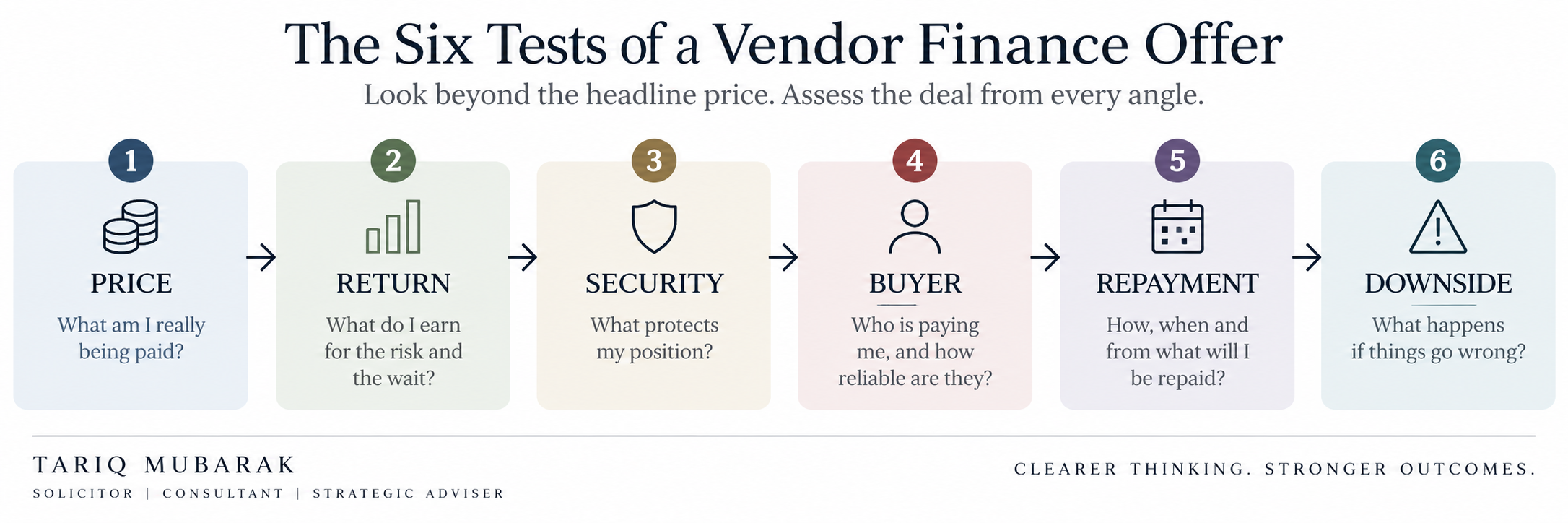
The six questions to put to any vendor-finance offer, before the headline price does your thinking for you.
I apply the same six to a £400,000 deferred balance on a suburban buy-to-let and to a much larger tranche on a development sale. Only the depth of the enquiry changes.
No single term makes a vendor-finance offer good or bad; the six have to be read together. Weak security can be acceptable where the buyer is strong, repayment is credible and the return properly pays for the residual risk. A high rate rescues nothing if repayment is speculative and recovery on default is remote. Strong security does not compensate for an economically thin return, and a good buyer does not cure a badly built repayment mechanism. What you are really doing is weighing how the six interact — which is commercial judgement, not a checklist.
1. Price — what am I really being paid?
The headline price is the least reliable figure in the offer. Split it in two. The cash you receive at completion is money that, once it is in your hands, is no longer exposed to your buyer’s later credit or recovery risk. The deferred balance is a real, legally enforceable obligation the buyer owes you — but until it is paid it remains exposed to their solvency, their performance and the practical business of recovering it. Headline price and economic value are not necessarily the same thing. So ask whether the premium on the headline genuinely compensates you for the wait and for that exposure. Very often a higher “price” is simply a larger number attached to a slice you may struggle to collect — and a premium you never receive is not a premium.
2. Return — what am I paid for leaving my capital exposed?
If you are leaving money in, you should be paid for it. Interest is the obvious form, but not the only one — a genuine price premium, fees or other benefits can all count. The questions are practical: what rate; is the interest serviced periodically or rolled up to the end; and is there default interest if payments are missed. Rolled-up interest you will not see for three years is itself a credit risk, not a comfort.
Resist the lazy benchmark. The right rate is not “a bit more than a mortgage”. A high-street mortgage is a first charge, to an underwritten borrower, at a conservative loan-to-value, from a lender with a full enforcement machine behind it. If you are taking a second charge behind a development facility, to a company with no track record, for three years, you are nowhere near mortgage risk, and mortgage pricing is irrelevant. The real question is what return compensates you for this buyer, this security, this duration, this liquidity exposure and the overall risk you are taking. There is no standard figure to reach for, and sometimes the honest conclusion is that no realistic rate compensates for a fundamentally unattractive structure — in which case the answer is “not on these terms”.
One more thing under return: if part of the attraction is the interest over a defined period, ask what happens if the buyer repays early. Agree a three-year structure for the yield and you may find the buyer refinances after six months, taking most of the expected return with them. Where the return matters, the terms can address that — voluntary prepayment, a minimum interest period, or a redemption fee or premium — so the real question is whether the buyer can repay whenever they choose, or whether you have secured an appropriate minimum return.
3. Security — if they don’t pay, what do I actually have?
This is where most attention goes and where it is most often misdirected. A common protection is a legal charge over the property, registered at HM Land Registry under the Land Registration Act 2002. Registered, it gives you rights against the property. But it is not accurate to say that without a charge you are simply an unsecured creditor with nothing — your position depends on the structure, the contract, the title arrangements and any equitable rights. If you retain legal title until you are paid, for instance, you may be considerably better protected than a paper “secured” second chargee. Precision matters here more than reassurance.
The trap is to treat “secured” as “safe”. Security is only worth what it will recover. A first charge securing a relatively modest balance against an otherwise unencumbered £600,000 property may give you a substantial equity cushion. A second charge behind a £480,000 development facility on the same property is a different proposition: it is still security over the property, but the practical recovery available to you depends on what value remains once the senior-ranking debt, enforcement costs and any prior claims are met — which, on a bad day, can be very little, or nothing. Even first-ranking security has to be judged by the amount secured, the property’s value and how volatile it is, the cost of enforcing, and any competing claims.
So look past the word “charge” to what it will actually deliver:
Ranking — first or second, and behind whom.
Whether a senior acquisition or development lender sits ahead of you, and whether their facility can increase through further advances, pushing you further down.
What the deed of priority or intercreditor deed actually permits — it often caps your recovery and restricts or delays your right to enforce.
Restrictions on the title controlling further charges or dispositions.
The equity cushion — today’s honest value, less prior debt, less the cost of realising it.
Guarantees, and whether there is anything real behind them.
The governing principle: judge security by the recovery it is likely to produce, not by the fact that it exists.
There is a second half to security that sellers routinely miss. Your charge protects you if the buyer defaults — but between completion and repayment it is the buyer who controls the property that is your main protection, sometimes for years. Good security is not only about what you can do after default; it is also about stopping your position being eroded before default. Depending on the size, length and risk of the deal, that can mean contractual and security terms governing what the buyer may do while your money is outstanding: taking on further borrowing or granting further charges over the property, disposing of it or refinancing, how the sale or refinancing proceeds are applied, keeping it insured and properly maintained, material changes to a development or business plan, and giving you the financial and property information — and, where the sum justifies it, the loan-to-value or reporting covenants — you need to see trouble coming. Not every deal needs every one of these; the protections should be proportionate to the amount, the duration, the asset and the risk. They are also what decides how much value is still there to enforce against on the day things go wrong.
4. Buyer — who am I trusting with my money?
A useful test is simple: would a commercial lender lend this buyer your money? You do not have to reproduce a bank’s underwriting — keep the enquiry proportionate to the size and risk of the deal — but you should apply the instinct.
Is the buyer an individual or a company? If a company, is it a newly-incorporated special-purpose vehicle with no assets and no history? An SPV is not a red flag in itself — it is how property is routinely held and financed — but it means the entity that owes you the money may hold nothing but the property, and the property already answers to the senior lender first. So establish who owns and controls the SPV, what their track record is, where the completion money is coming from, who else is lending, and whether anyone stands behind the SPV by way of guarantee. Then test any guarantee rather than simply taking it: a guarantee from a guarantor with demonstrable net assets against which a judgment could realistically be enforced changes the picture, while a guarantee from another asset-less company changes nothing. Wealth on paper is not the same as recoverability — what matters is what the guarantor actually owns, what is already charged to others, where the assets are, how liquid they are, and who else would be competing for them. A guarantee is only as useful as the covenant and the practical recoverability behind it.
5. Repayment — where is my money actually coming from?
This is distinct from security, and routinely confused with it. Security is your fallback if the deal goes wrong. Repayment strategy is how the deal is supposed to go right. You need both to stand up.
Vendor-finance repayment usually rests on one of a few plans: “we’ll refinance in three years”, “we’ll sell once the works are done”, “the rent will cover it”, “it’ll be worth £X”. Each is a set of assumptions dressed as a certainty, and each deserves interrogation. “We’ll refinance” means a future lender, at a future date, on future criteria, at a future valuation, will advance enough to pay you out — so you are, in effect, taking a position on the lending market three years from now, a market you neither control nor can predict. “We’ll sell” depends on a future buyer at a future price. “It’ll be worth £X” depends on the works finishing on budget, planning behaving and the market cooperating. Ask what has to be true for you to be paid, and how much of it is within anyone’s control. If the whole plan rests on a single refinancing at a valuation nobody can yet stand behind, you know exactly where the risk sits.
6. Downside — what happens if the plan fails?
This is the test that separates a considered decision from a hopeful one, and it is the one sellers skip.
A charge looks reassuring on the day you complete. Its real value is tested on the day the buyer stops paying — and that is a different day entirely.
Private creditors, and even experienced lenders, pour effort into obtaining security and give almost no thought, before completion, to what using it would actually take. Enforcement is not a button. It is a process — often slow, expensive, management-intensive and stressful — and if a senior lender ranks ahead of you, it may largely be their process, run on their timetable and in their interest, not yours.
Before you sign, think through the day it goes wrong, proportionately to what is at stake:
What counts as a default, and are there cure periods?
Can you accelerate — call in the whole balance at once?
What can you actually do? The remedies — a power of sale, appointing a receiver, taking possession, suing on a guarantee — are not automatic: they depend on the security instrument, the statute behind it and where you rank, and a senior lender’s deed of priority may restrict or delay them.
What will it cost — solicitors, receivers, valuers, perhaps insolvency practitioners — and, crucially, who funds those costs up front? You do, out of your own pocket, while chasing money you are already not being paid.
How long will it realistically take, and what happens to the property, and its value, while it drags on?
Does interest keep running, and will the eventual recovery actually cover it?
After the senior debt, the costs and any prior claims, how much equity is genuinely left for you?
Is the guarantee worth suing on, and do you have the money, time and appetite to run all of this?
And do not assume your security will fund its own enforcement. You can hold a valuable charge and still need real liquidity to realise it — those costs fall to be paid before any recovery arrives. There is a difference between holding an asset-backed claim and having the practical ability to enforce it, and only the second one pays you.
This is not a reason to refuse vendor finance. It is a reason to go in default-prepared — documentation right, an adviser identified, a rough budget in mind, the senior lender’s rights understood. Failure to plan for enforcement can itself destroy value. When a deal goes bad you are already dealing with a deteriorating situation; discovering only then that your documents are thin, your charge ranks behind a facility you never scrutinised, and you have no adviser and no budget, turns a recoverable problem into a loss.
Why would a sensible seller ever agree?
Nothing above is an argument against vendor finance. Done with eyes open, it can be the best deal on the table — and for a sophisticated vendor it is rarely a mere concession to a buyer who is short of funds. It can be a deliberate capital-allocation decision: realising most of your capital at completion while choosing to keep a defined, return-bearing exposure to the rest for a fixed period, without holding on to the asset itself. Seen that way, it can make real commercial sense where:
the overall return is better — interest plus a genuine premium can beat a clean cash offer once you have priced the risk honestly;
it widens your buyer pool — some good buyers, particularly developers and portfolio builders, structure this way by choice, and insisting on all-cash can cost you them;
you want income — a serviced deferred balance is a return on capital that would otherwise sit in the bank;
it gets a viable deal done — a keen buyer temporarily short of the last slice of funding, on an asset you are happy to sell, may be worth accommodating;
it moves stock — a developer with completed units, or a landlord with a portfolio, can accelerate disposals by offering terms;
it structures your receipts — staged payment sometimes suits your own cashflow or tax position (take advice on that).
The honest conclusion is this: vendor finance is neither inherently clever nor inherently dangerous. Whether it is a good idea depends on the economics, the buyer, the security, the repayment plan and the downside — the six things this article has just walked through.
A worked example
Here is a set of numbers that looks fine until you ask questions. A buyer offers to acquire a tenanted flat you own for £600,000:
£200,000 in cash on completion;
£400,000 left outstanding for 36 months;
interest at 7% a year;
repaid when the buyer refinances or sells within the three years;
secured by a legal charge over the flat;
the buyer being a newly-incorporated property SPV.
On the face of it: £600,000 for a £600,000 flat, £200,000 now, 7% on the rest, a charge for security, repaid in three years. Attractive. Now apply the tests, and watch how little you actually know.
Price. £600,000 headline; £200,000 received at completion and beyond the buyer’s later credit risk. The other £400,000 is an enforceable obligation — but its value depends on everything below going right.
Return. 7% — but serviced monthly, or rolled up so you see nothing for three years? Rolled-up interest is more money you are not being paid, on top of principal you are not being paid.
Security. A charge — but ranking where? If the £200,000 comes from an acquisition lender, that lender takes the first charge and yours is a second, behind a facility that may be able to grow. “Secured” here could mean a restricted second charge whose real recovery depends on the value left after the senior debt — a very different thing from what the offer implied.
Buyer. A brand-new SPV — owned and run by whom, with what track record? The company that owes you £400,000 may own one asset, this flat, which already answers to a senior lender first. Is anyone guaranteeing it, and are they good for it?
Repayment. “Refinance or sell in three years.” Refinance to what value, at what loan-to-value, in what market? What must the flat be worth in 2029 for a lender to advance enough to clear the senior debt and pay you out? If that requires an aggressive future valuation or loan-to-value assumption, the repayment plan deserves much closer scrutiny.
Downside. If they stop paying in month 20, with the senior lender ahead of you and rolled-up interest mounting: what do you actually recover, after their debt and your enforcement costs, and how long and how much does getting there take?
The point is not that this is a bad deal. It might be a very good one. The point is that a seven-line proposal does not contain nearly enough to tell — and the gap between “£600k, 7%, secured” and the real economics is exactly where the seller’s real exposure lies.
A shorter commercial illustration. Scale it up. A developer sells a £3m investment asset, or a consented site, and accepts £2m on completion with £1m deferred, because the blended economics are genuinely attractive and the buyer is a credible operator. Perfectly reasonable — provided the seller knows precisely what sits between them and that £1m. If the buyer’s development lender ranks ahead with a facility that grows as the scheme draws down, the seller’s £1m “second charge” may in practice recover only the value left in a completed — or half-completed — development once the senior debt is cleared. Same six tests; bigger numbers; the security and downside questions matter more, not less.
Received a proposal like this?
I can review the actual offer against Price, Return, Security, Buyer, Repayment and Downside before you commit.
A note on regulation
The regulatory position differs materially according to the identity of the buyer, the nature and use of the property, the security taken and the precise structure. Particular care is required where an individual is buying residential property on secured credit, as the regulated mortgage and/or consumer-credit regimes may be engaged. The risk is most acute where an individual is buying and residential property secures the balance. Such arrangements can potentially fall within the regulated mortgage regime under the Financial Services and Markets Act 2000 (Regulated Activities) Order 2001 and the FCA’s mortgage rules (as amended for the Mortgage Credit Directive from 2016, which brought second charges over residential property into scope), or within consumer-credit regulation. Whether any of it bites turns on the precise facts — who the borrower is, what the security is, and whether the seller is acting by way of business. It is fact-sensitive, it is not a reason to panic, and it is a question to resolve before heads of terms, not after. Where individuals and residential property are involved, take specialist perimeter advice early.
Tax — a flag, not advice
Vendor finance can change both the timing and the nature of your tax liabilities, and the buyer may face SDLT that does not track the timing of the payments they make to you. That affects both the economics of the deal and the buyer’s day-one funding requirement — and therefore whether the structure works at all. Tax treatment here is structure- and fact-dependent, so model it with a tax specialist before terms are agreed.
For estate agents
You will usually be the first to receive one of these offers, often by phone and framed enthusiastically. There are two instincts to resist: rejecting it out of hand, and waving it through.
Reject a viable structure and you may cost your client a good sale. Nudge them into a bad one and you have put the relationship — and arguably your standing — on the line. The safe and genuinely helpful position is neither: make sure the proposal is properly understood and independently reviewed before your client decides.
You do not need to structure property finance. You do need to pin down the basics before you take the offer to your seller:
how much is cash on completion, and how much is deferred;
over what term;
who the buyer is — individual or company, and if a company, who is behind it;
whether another lender is involved;
what security the buyer expects your client to take;
how repayment is supposed to happen;
whether any guarantee is on offer.
With those seven answers the offer can be assessed properly, and a viable deal kept alive rather than killed by a nervous “no” or waved through on a hopeful “yes”. When a vendor of yours receives an unusual offer, sending them for an independent, seller-side review protects them — and protects you.
A different way of looking at these deals
Most vendor-finance commentary is written for buyers: how to acquire with less capital in. I look at the same proposal the other way round, and through two lenses at once — it is a property transaction and a credit exposure. The conveyancing can be immaculate and the deal still poor, because the risk lived in the finance, not the title. The six tests are simply how I read that risk before a client commits their capital to it.
Frequently asked questions
What is vendor finance?
Vendor finance (also called seller finance) is where the seller of a property agrees to leave part of the purchase price outstanding after completion, to be paid later — sometimes with interest, sometimes secured against the property. In substance, the seller is extending credit to the buyer. It covers a spectrum from a formal, secured vendor loan to simple deferred consideration.
Is vendor finance legal in England and Wales?
Yes. There is nothing unlawful about a seller agreeing to be paid part of the price over time. Certain structures — mainly where an individual buys residential property on secured credit — can engage financial regulation, so the position should be checked before terms are agreed.
Am I becoming a lender?
In substance you are becoming a creditor of your buyer — you are owed money after completion. Whether you are a “lender” in a formal sense depends on the structure: an interest-bearing, secured vendor loan is close to lending; fixed deferred consideration is a contractual debt, not a loan. Either way, the risk questions you should ask are a lender’s questions.
Why would a seller agree?
For a better overall return, a price premium, interest income, a wider buyer pool, or to get an otherwise good deal done. It makes sense when the economics, buyer, security, repayment and downside all hold up — not simply because the headline price is higher.
Is a higher price paid later better than a lower cash offer now?
Not necessarily. Cash received at completion is no longer exposed to the buyer's subsequent credit risk; a higher price paid over time leaves part of the consideration outstanding and exposed. Compare what you actually receive, when, what you earn for waiting, and what you would recover if the buyer failed.
What security should I ask for?
Commonly a legal charge over the property, registered at HM Land Registry — but its value depends on its ranking and the equity behind it, not on merely having it. Depending on the structure, guarantees, title restrictions, or retaining legal title until you are paid may matter as much or more.
What is the difference between a first and second charge?
A first charge is paid out first from the property; a second charge is paid only after the first lender is satisfied. A second charge behind substantial senior debt may recover little on enforcement, even though the property is “charged”.
Should I accept a second charge?
Sometimes — but only once you know how much ranks ahead of you, whether it can grow, what the deed of priority lets you do on default, and how much equity is realistically left for you. A second charge is still security over the property, but in practice you recover only what value remains after the senior debt, enforcement costs and any prior claims.
What if the buyer uses an SPV?
Very common, and not a problem in itself — but the SPV may own only the property and hold no other assets, so it is worth understanding who controls it and whether anyone stands behind it. A guarantee from a substantial party changes the risk; a guarantee from another empty company does not.
Should I ask for a personal or parent-company guarantee?
Often yes, where the buyer is a thin SPV — but a guarantee is only as good as the guarantor’s recoverable net assets. Establish what the guarantor actually owns, what is already charged, and whether a judgment could realistically be enforced before relying on it, and note that an individual guarantor should usually take independent legal advice for the guarantee to be robust.
What interest rate should I charge?
Enough to compensate you for this buyer, this security, this duration and this risk — there is no standard rate, and mortgage pricing is the wrong benchmark. Also decide whether interest is serviced periodically or rolled up, and whether default interest applies.
What happens if the buyer defaults?
You would rely on your contractual remedies and any security — potentially calling in the balance, appointing a receiver, taking possession or suing a guarantor. In England and Wales those remedies are not automatic, enforcement can be slow and costly, a senior lender may control the timing, and you generally fund the costs yourself up front.
What if the buyer cannot refinance?
Then a repayment plan that depended on refinancing has failed, and you fall back on your security and remedies — which is precisely why the downside must be assessed before you agree. A seller relying on the buyer’s future refinancing is indirectly betting on the lending market and valuations years ahead.
Could financial regulation apply?
It can, mainly where an individual is buying residential property on secured credit. Deals with companies or SPVs, or over commercial property, usually fall outside the consumer regimes — but not always. It is fact-sensitive under FSMA 2000 and the Regulated Activities Order, so take specialist advice before heads of terms if individuals and homes are involved.
Are there tax implications?
Yes. Vendor finance can change the timing and nature of your tax, and the buyer’s SDLT may not track the payments they make to you — which can affect both the economics and the buyer’s day-one funding. The treatment is structure- and fact-dependent, so model it with a tax specialist before you commit.
Should I obtain advice before accepting heads of terms?
Yes — the terms you concede at heads-of-terms stage are the hardest to claw back later, and the structure is easiest to fix before anyone is committed. A short, seller-side review of the proposal before you agree anything is the cheapest point at which to protect your position.
Received a vendor-finance offer?
If a buyer has asked you to leave part of the price outstanding, the Vendor Finance Offer Review helps you decide whether it is commercially worth pursuing and, if so, on what terms — before you accept or agree heads of terms. The outcome is rarely a plain yes or no: it might be decline, investigate further, renegotiate, restructure, or proceed — a weak proposal often carries the makings of a good deal once it is put together properly.
Send the proposal, the property details, what you know about the buyer, and any lender involved. I review it in advance against Price, Return, Security, Buyer, Repayment and Downside, then talk it through with you in a 45-minute Microsoft Teams consultation: where the real risks are, what is missing, what to negotiate, and whether the deal in front of you stacks up from the seller’s side.
Fixed fee.
Advance review of your actual proposal.
3–5 working-day standard turnaround.
A 45-minute Teams consultation.
Entirely seller-side.
If the proposal is worth pursuing, further help with restructuring, negotiation and implementation can be scoped separately.
Estate agents: if a client of yours has received a vendor-finance, deferred-consideration or other unconventional offer, you are welcome to refer them for an independent, seller-side review before they decide. You keep the relationship; your client gets a straight answer.
About the author
S. Tariq Mubarak is a solicitor of England & Wales with more than 25 years' experience advising on real estate, property finance, secured lending and complex property transactions. His work combines legal analysis with the commercial structuring of property transactions and investment risk.